
Week 309 · Panama Canal · Panamá Viejo · One Day Layover
Panama
I had done a similar trip with a one-day layover on my own back in 2014, so when the option came up to have a one-day layover from San Jose on Copa Airlines, we took it. We had a rough departure — upon arrival they advised we had missed our flight as it had changed from a 737-MAX to a much smaller plane and they had rebooked us on the flight earlier in the day. Luckily we made it.
Once we arrived in Panama City, Uber had no cars available so we found a reasonably non-sketchy guy to give us a ride to the hotel late at night. He ended up being a good connection as my available time for touring the following day had been reduced (work thing) and we agreed on him giving us the city tour the next day and taking us back to the airport — much faster than the hop-on/hop-off bus. At the hotel, they didn't have my reservation locally but it was on the corporate system and after a while they checked us in — we got the largest hotel room I have ever seen: the "Royale Suite." So ended up OK by the end of a long day. Quite the diversity of rooms for a short trip.
The "work thing" lasted longer than expected so having the personal driver was key as we were crunched on time. Based on my 2014 trip, I was thinking to go to 4 places, but with the time crunch we limited ourselves to 2: the Panama Canal and Old Panama City (Panamá Viejo).
We supplemented our guide using local maps — point and say "take us there." By accident we walked by the Presidential residence. Between canal tolls and offshore bank accounts, quite a skyline for a moderate-sized city.

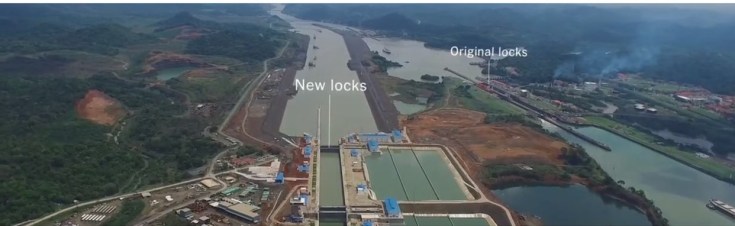
Truly amazing what was done over 100 years ago — still in use even alongside the new Panama Canal. Didn't have time for the full tour, but the museum explains the history well. Took two tries before they achieved enough momentum to complete construction — the French started in the late 1800s but quit because too many workers were dying. The USA started again in 1904 and finished in 1914. Most of the "canal" is actually through a manmade lake and after it was transitioned from the USA to Panama, the toll changed from breakeven to market pricing — a huge impact to the Panama economy. The new canal was finished in 2016. My old company (which is my current company) lost the bid and the winner was rumoured to be losing $1 billion — reality was closer to $3 billion.
The Panama Canal stretches 82 kilometres across the Isthmus of Panama and connects the Atlantic and Pacific Oceans, eliminating the need to sail around Cape Horn. France first attempted construction in 1881 under Ferdinand de Lesseps (who had built the Suez Canal) but abandoned the project in 1889 after approximately 22,000 workers died, mostly from malaria and yellow fever. The United States took over in 1904, eradicating mosquitoes through a massive public health campaign, and completed the canal in 1914. Panama assumed full control in 1999. The expansion project completed in 2016 added a third set of locks capable of handling the massive "New Panamax" container ships — the original locks were built to the width of the widest ship their engineers could imagine at the time. The expansion cost approximately $5.25 billion and was completed over budget and years behind schedule by a consortium led by a Spanish construction firm.


On my prior trip, when I went to the old city centre we got 45 minutes to walk around and the bus wasn't allowed to the truly historic part of town. So this time with a better starting point, a guide, and more time, we saw a lot more. Very interesting combination of Spanish colonial influence (Independence in 1821), Colombian influence (Separation 1903), and French influence from when they tried to build the canal. Restoration of the buildings has continued from my last trip and now enough buildings are restored with hotels, restaurants, and coffee shops that it appears it would be a nice place to stay over.
Between the Spanish and the French, the primary sites are Catholic churches — a lot for such a small area — as well as views of downtown and the Pacific Ocean.


"Truly amazing what was done over 100 years ago — still in use even with the new Panama Canal. The winner of the expansion bid was rumoured to be losing $1 billion. Reality was closer to $3 billion."